.svg)



Adviser numbers declined 2.5% over the 12 months to March 2026, dropping by a net 389 advisers to 15,157, according to Rainmaker Information’s latest Financial Adviser Report.
“This marks the lowest recorded level since June 2003, reflecting ongoing consolidation, regulatory pressures, and evolving business models across the sector,” said David Gallagher, executive director of research at Rainmaker Information.
He added that the decline is being further driven by continued industry disruption, particularly the Financial Adviser Standards and Ethics Authority (FASEA) mandated education and training requirements, which carried a 1 January 2026 deadline for all existing Australian financial advisers.
Quarterly trends remain consistent, with adviser numbers slipping a further 0.7% (100 advisers) over the March 2026 quarter.
At the same time, the number of Australian Financial Services Licensees (AFSLs) also contracted, falling 1.4% over the year to 1,840.
“Mid-sized licensees are emerging as a growth segment, while larger institutions continue to rationalise adviser footprints.” said Gallagher.
“The data highlights a clear divergence across licensee size cohorts.”
“Mid-sized AFSLs with 11–50 advisers recorded the strongest growth, expanding adviser numbers by 10.4% over the year.”
In contrast, large licensees, those with more than 250 advisers, saw a sharp 17.9% decline in aggregate adviser numbers.
During the March quarter, only licensees in the 11–50 and 101–250 adviser bands recorded growth, collectively adding 256 advisers while all other segments contracted.
Among the AFSLs, Entireti remains Australia’s largest financial advice group with 1,034 registered advisers, albeit down 78 advisers through the 12 months to March 2026.
Count is the second largest with 570, also down by 78 advisers in the year to March 2026.
The groups that increased their number of advisers in the year to March 2026 were Fortnum Advice (+35), Canaccord Genuity (+32), RI Advice Group (+19) and Alliance Wealth (+19).
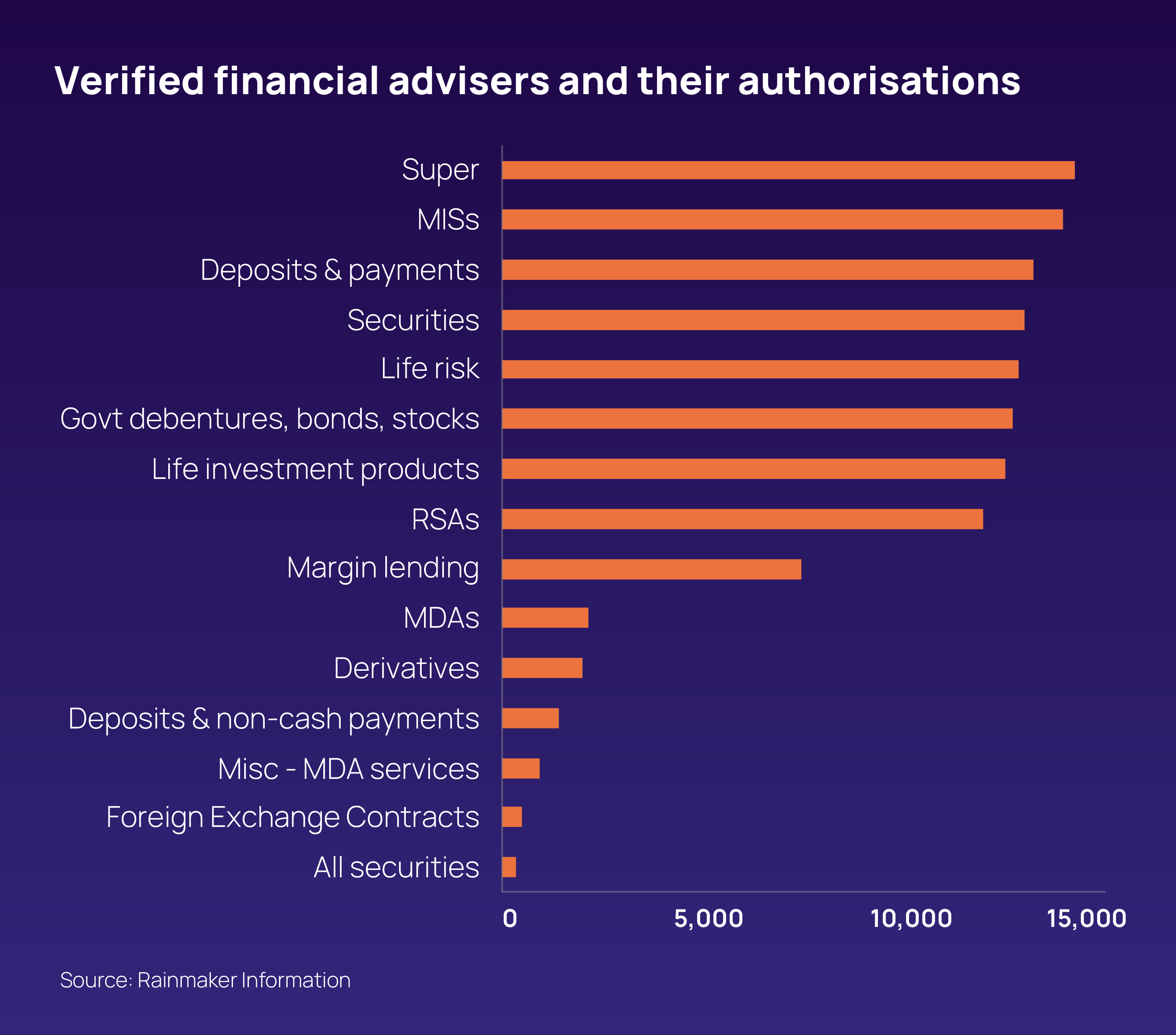
Further insights into adviser activity reveal uneven changes across areas of authorisation.
Adviser authorisations grew modestly over the year in securities (0.3%) and life investment products (0.2%), while more pronounced declines were recorded in derivatives (-4.8%), margin lending (-2.0%), and deposits and payments (-1.6%).
Notably, non-cash payments saw a sharp 16% increase over the past twelve months, signalling pockets of emerging growth.
Superannuation advice is the most common authorisation, held by 93.9% of advisers, followed by managed investment schemes (92.0%), deposits and payments (87.2%), securities (85.6%) and life risk (84.6%).
Contact our Business Development team to receive further details of Rainmaker's products and services.

Internally managed assets have more than doubled in five years—rising from an estimated $227 billion in 2020 to $550 billion in 2025.

Australian ETP market records $51.9 billion in net flows for 2025, up 60% year-on-year

