.svg)


Australia's financial advice profession has reached a major milestone, with 85% of current advisers now holding qualifications at bachelor degree level or higher, according to Rainmaker Information’s latest Financial Adviser Report.
The industry's long-running educational reforms, introduced following concerns about professional standards across the sector, have fundamentally reshaped the qualification profile of Australia's financial advisers.
Graduate diplomas are now the most common qualification among practising advisers, held by 35% of the workforce, while almost all advisers entering the profession in recent years hold university-level qualifications.
“The transition officially concluded at the end of 2025, requiring advisers to meet new education standards either through approved qualifications or the Experienced Provider Pathway, which recognises long-serving advisers with strong compliance records,” said Pooja Antil, senior research manager at Rainmaker Information.
The Financial Adviser Standards and Ethics Authority (FASEA) professional standards regime, which took effect from 1 January 2019 have transformed the profession over the past decade.
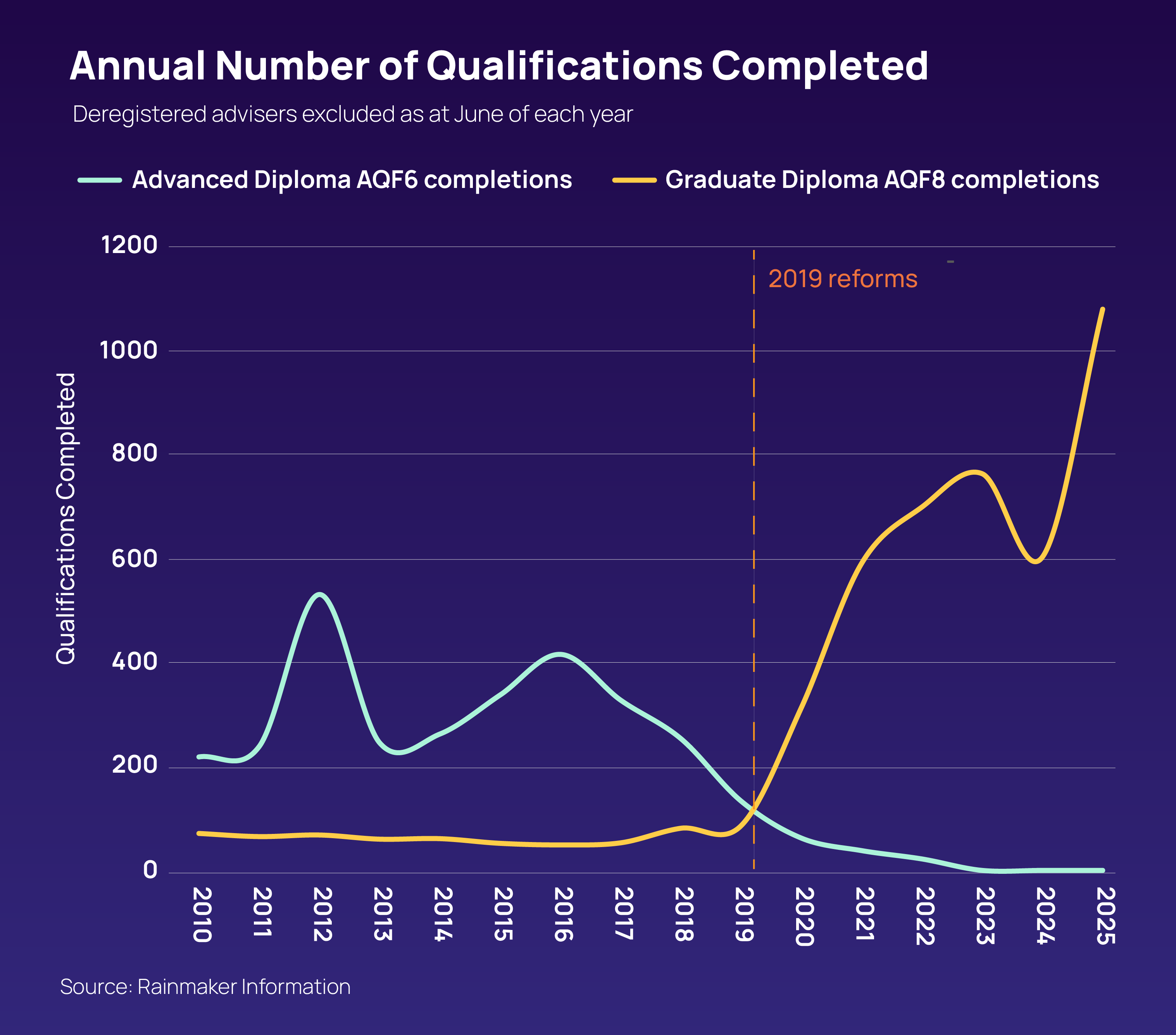
Before the reforms, the Advanced Diploma was the dominant qualification pathway.
As education requirements tightened, Graduate Diploma completions surged, peaking in 2025 as advisers completed study requirements ahead of the final deadline.
Today, around two-thirds of advisers hold either a bachelor’s degree or Graduate Diploma as their highest recorded qualification, while every adviser entering the profession since 2019 holds a qualification at a bachelor’s degree level or above.
At the same time, the reforms recognised the value of experience.
For the first time, AFSLs are required to report to ASIC’s Financial Advisers Register how each adviser met the standard. 70% of current advisers have at least one qualification marked as going towards the standard, licensees report 37% as relying on the Experienced Provider Pathway, and 8% show both.
“A lower recorded qualification level does not necessarily indicate an adviser has failed to meet regulatory requirements, with almost all advisers without a bachelor’s degree having an identifiable pathway that allows them to continue practising under the new standards,” said Antil.
Almost a quarter hold designations such as Certified Financial Planner (CFP), Chartered Financial Analyst (CFA), Chartered Accountant (CA) or Certified Practising Accountant (CPA), while 61% belong to a recognised professional association.
The findings suggest educational standards have become firmly embedded within the financial advice profession, although additional professional accreditation remains less common.
These reforms have also coincided with a smaller, but more highly qualified, adviser workforce.
The research also found 746 advisers permanently left the Financial Adviser Register in January 2022 alone, following the introduction of the adviser exam requirements, which was around ten times the normal monthly exit rate.
“Today's education profile reflects advisers who successfully remained in the profession through the reform period,” said Antil.
What It Means for Consumers
For Australians seeking financial advice, the research suggests today's advice profession is significantly more qualified than it was a decade ago.
New entrants now face substantially higher education requirements before they can advise retail clients, while experienced advisers have been required to demonstrate either recognised qualifications or eligibility under the industry's experience-based transition pathway.
The result is a profession where degree-level education has become the norm rather than the exception.
Contact our Business Development team to receive further details of Rainmaker's products and services.

Internally managed assets have more than doubled in five years—rising from an estimated $227 billion in 2020 to $550 billion in 2025.

Australian ETP market records $51.9 billion in net flows for 2025, up 60% year-on-year

