.svg)


In 2026, we continue to see a rapidly evolving superannuation system, with total assets reaching approximately $4.4 trillion.
Growth across MySuper, Choice and retirement segments remain strong, while market concentration continues to increase, and platforms and managed accounts play an increasingly important role in how portfolios are constructed and delivered to members.
At the same time, regulatory scrutiny is intensifying, with a greater focus on investment governance, transparency, and delivering measurable outcomes across the member lifecycle, alongside continued shifts in asset allocation and the role of private markets within portfolios.
Total superannuation funds under management reached $4.4 trillion as at March 2026. The total assets in superannuation have grown by an impressive 118% over 10 years to March 2026, highlighting the strong long-term expansion of the system.
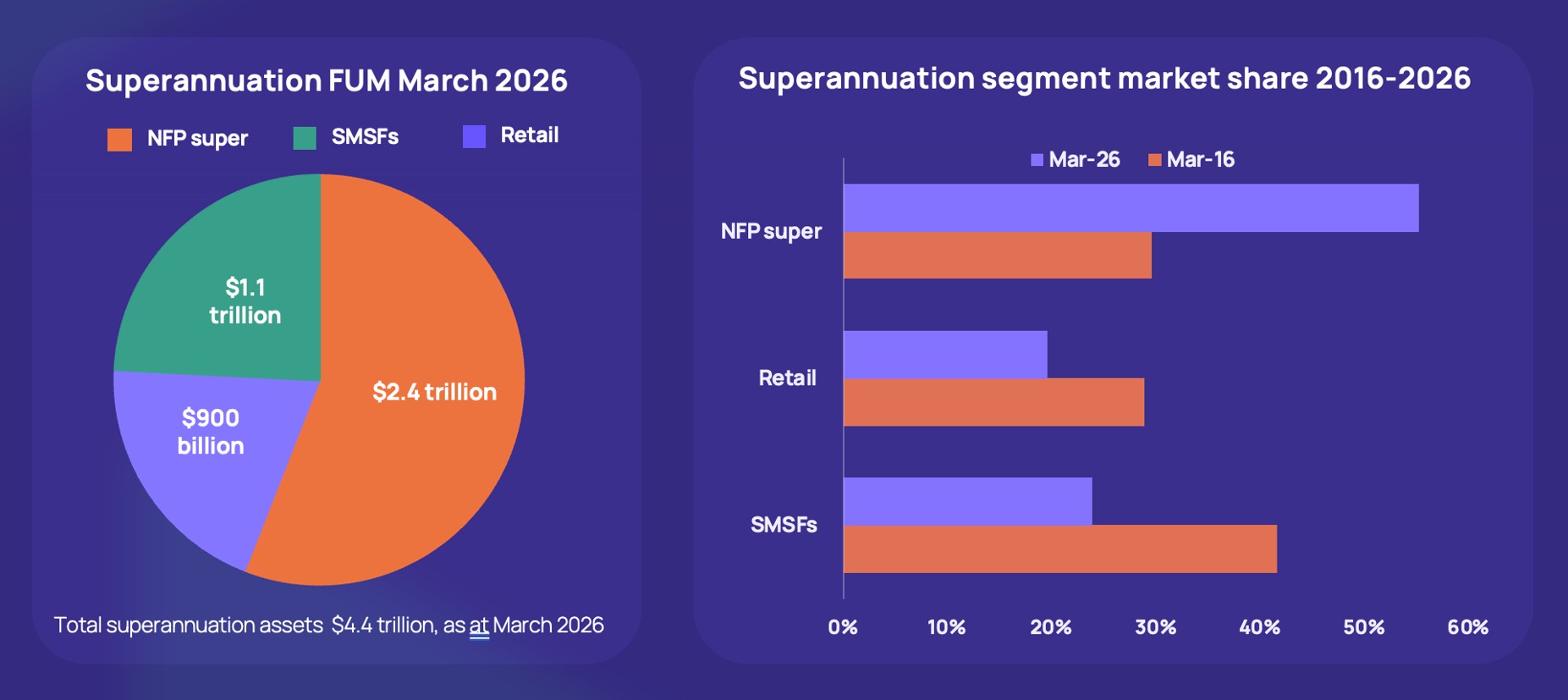
Over the past ten years the market structure has shifted quite materially as illustrated by Figure 1. The not-for-profit sector has been the clear winner, increasing its share from around 30% to 55% over the past decade. In contrast, SMSFs have declined from 42% to 24%, while retail funds have reduced from 29% to around 20%.
Overall, what this tells us is that scale, efficiency, and consolidation continue to reshape the competitive dynamics of the industry.
Product segmentation within APRA-regulated superannuation funds listed in Table 1, shows that MySuper remains a core pillar of the system, with approximately $1.2 trillion out of total $3 trillion in APRA-regulated assets. Alongside this, choice products account for around $1.5 trillion, split between $927 billion in accumulation products and about $600 billion in retirement products, while defined benefit funds represent roughly $150 billion.
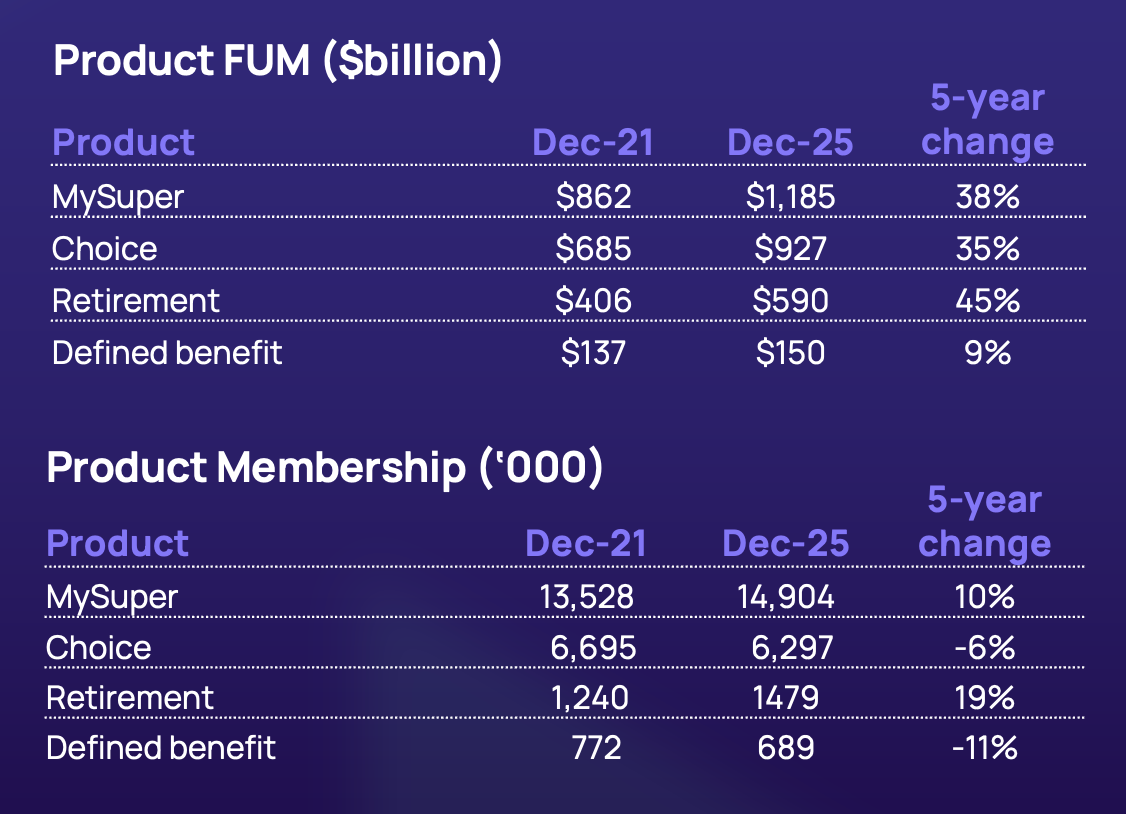
What is particularly notable here is the growth in retirement products. Over the five years to December 2025, retirement funds under management (FUM) recorded the strongest growth at 45%, reflecting the ageing member base. This trend is also evident in account growth, where retirement accounts increased by 19%, compared to 10% growth in MySuper accounts, while choice and defined benefit accounts have declined.
This shift toward retirement products is expected to accelerate further as demographics continue to evolve and more members transition into retirement.
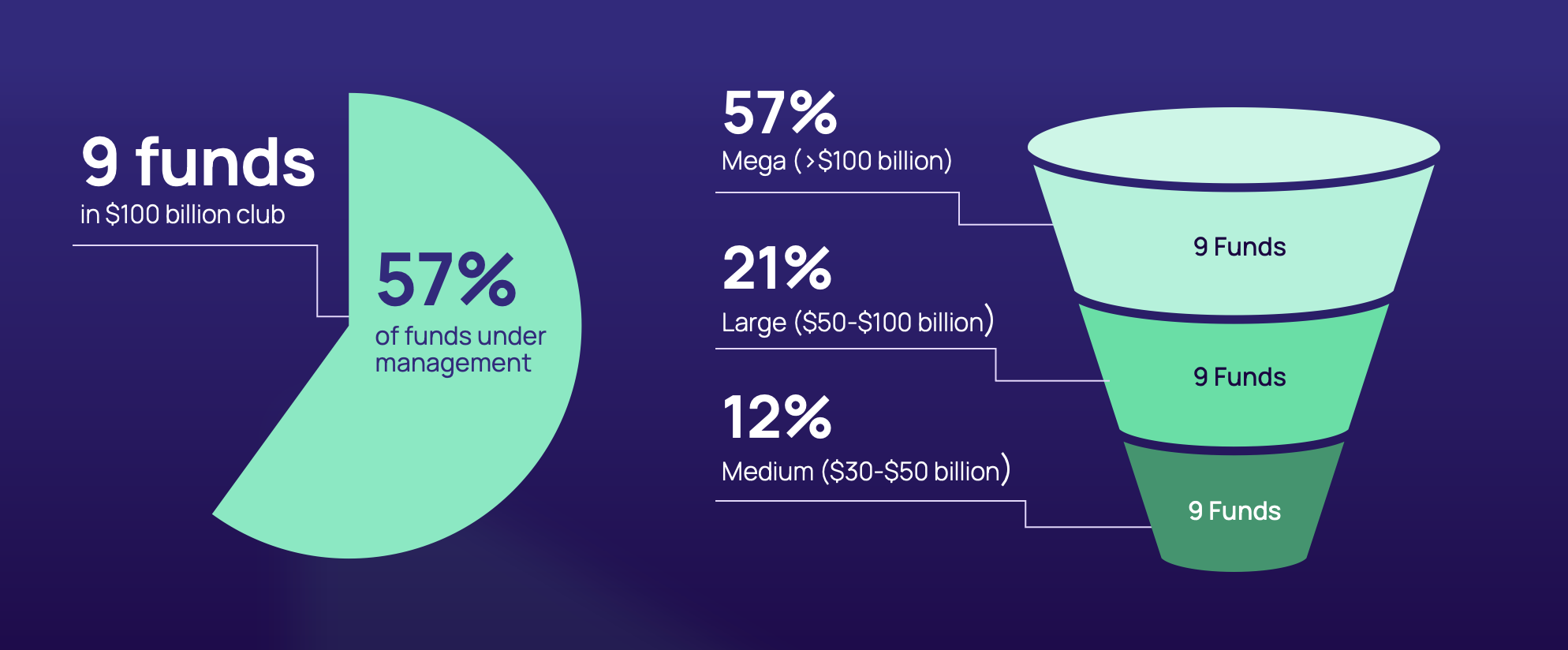
From a market composition perspective, Figure 2 highlights the continued concentration within the superannuation sector.
Currently, nine funds each manage over $100 billion, and together they account for approximately 57% of total superannuation assets. Funds in the $50–$100 billion range hold a further 21%, while mid-sized funds between $30–$50 billion account for another 12%.
In total, just 27 funds control around 90% of all superannuation assets, reinforcing how concentrated the industry has become.
While consolidation activity may begin to stabilise, the structural trend toward scale and concentration is expected to remain firmly in place.
Within APRA-regulated superannuation funds, equities continue to dominate for the obvious reasons.
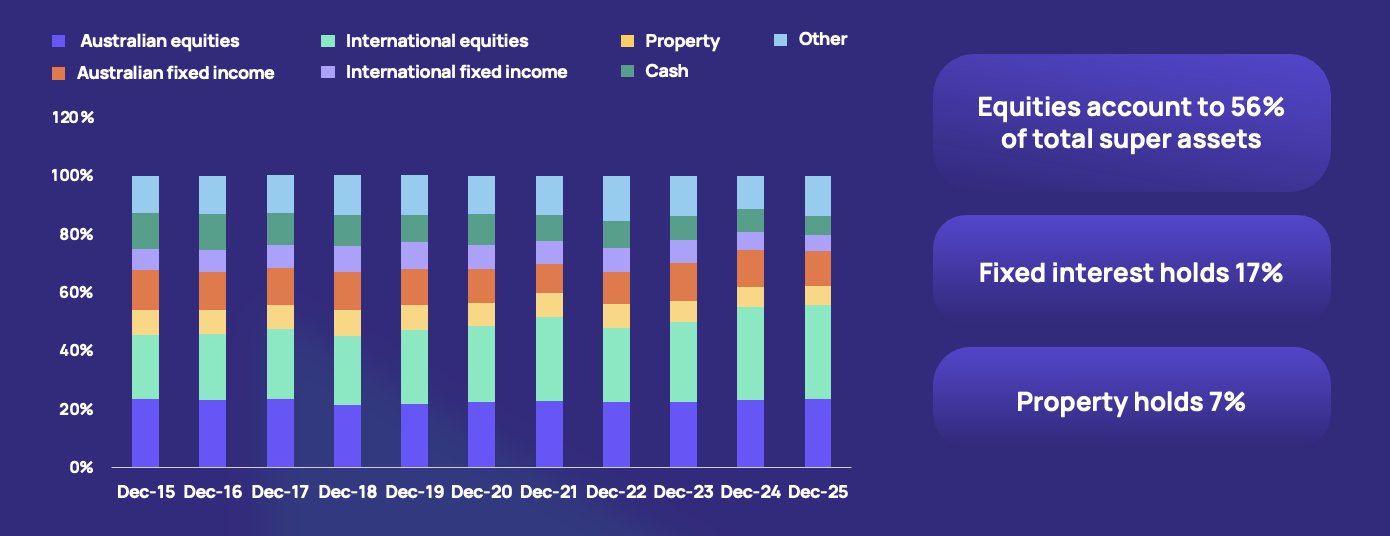
As depicted in Figure 3, international equities account for approximately 32% of total assets, and when combined with Australian equities, overall equity exposure increases to 56%. This concentration is consistent with earlier observations that equities remain the primary driver of returns; however, higher allocations to listed equities also elevate overall market risk exposure and the downside risk.
This increased allocation has largely come at the expense of defensive assets. Cash allocations have halved, from around 12% to 6%, while property and fixed income have seen modest reductions.
Other asset classes, including alternatives, have grown slightly, reflecting ongoing diversification—particularly into private markets.
"SMSF sector assets have reduced over time however we are seeing an uptick in outward rollover activity from super funds, benefiting the sector."
Private debt has been a key area of interest, experiencing strong growth in recent years, albeit from a smaller base. Figure 4 shows allocation to private assets as of June each year, and the latest data is as of December 2025 represented by the green column.
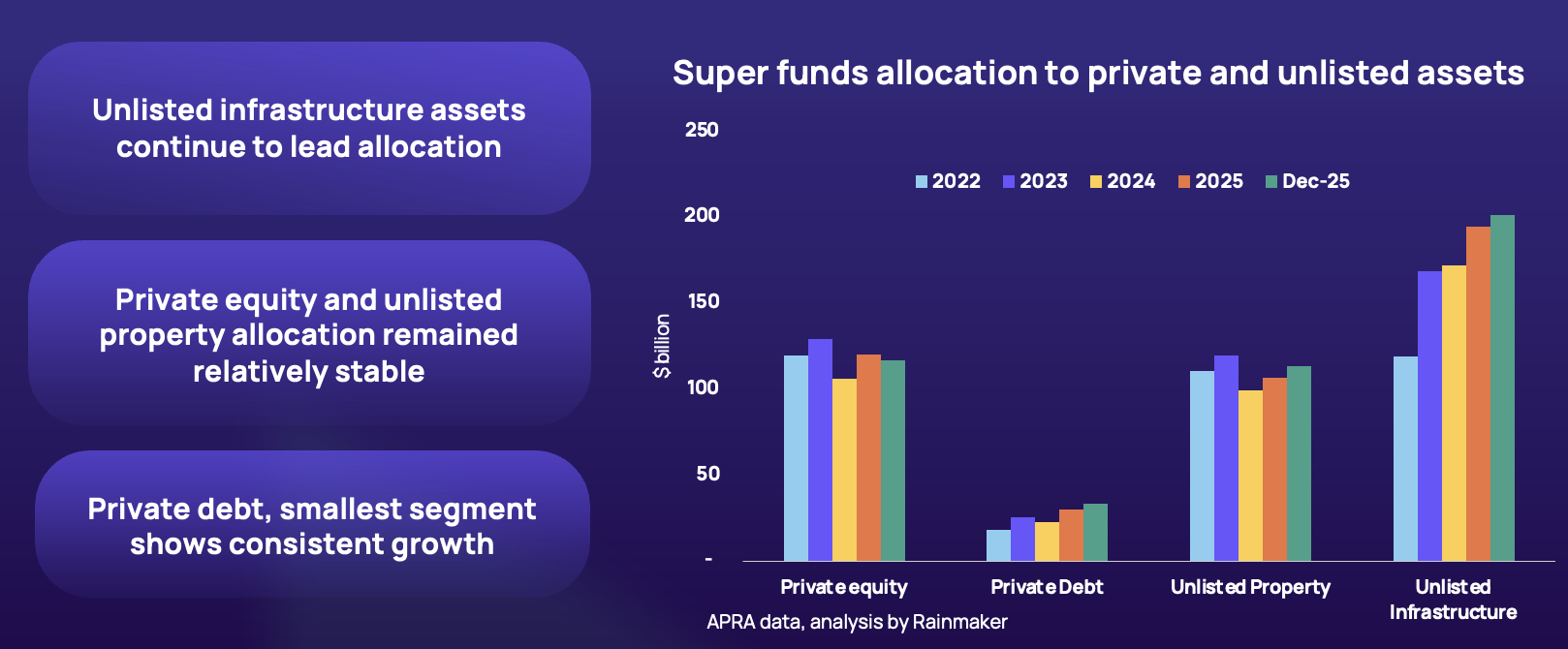
As of end December 2025, there was a total of $34 billion invested in private debt. At the same time, unlisted infrastructure continues to lead allocations, rising steadily from $120 billion in June 2022 to $200 billion by December 2025, reflecting strong demand for stable, inflation-linked income streams. Allocations to private equity and unlisted property remain relatively stable suggesting ongoing repricing and valuation adjustments.
This links closely to another major structural trend—internal investment management. As funds continue to scale, particularly within the industry superannuation sector, there is increasing focus on bringing investment capabilities in-house to gain greater control, flexibility, and cost efficiency.
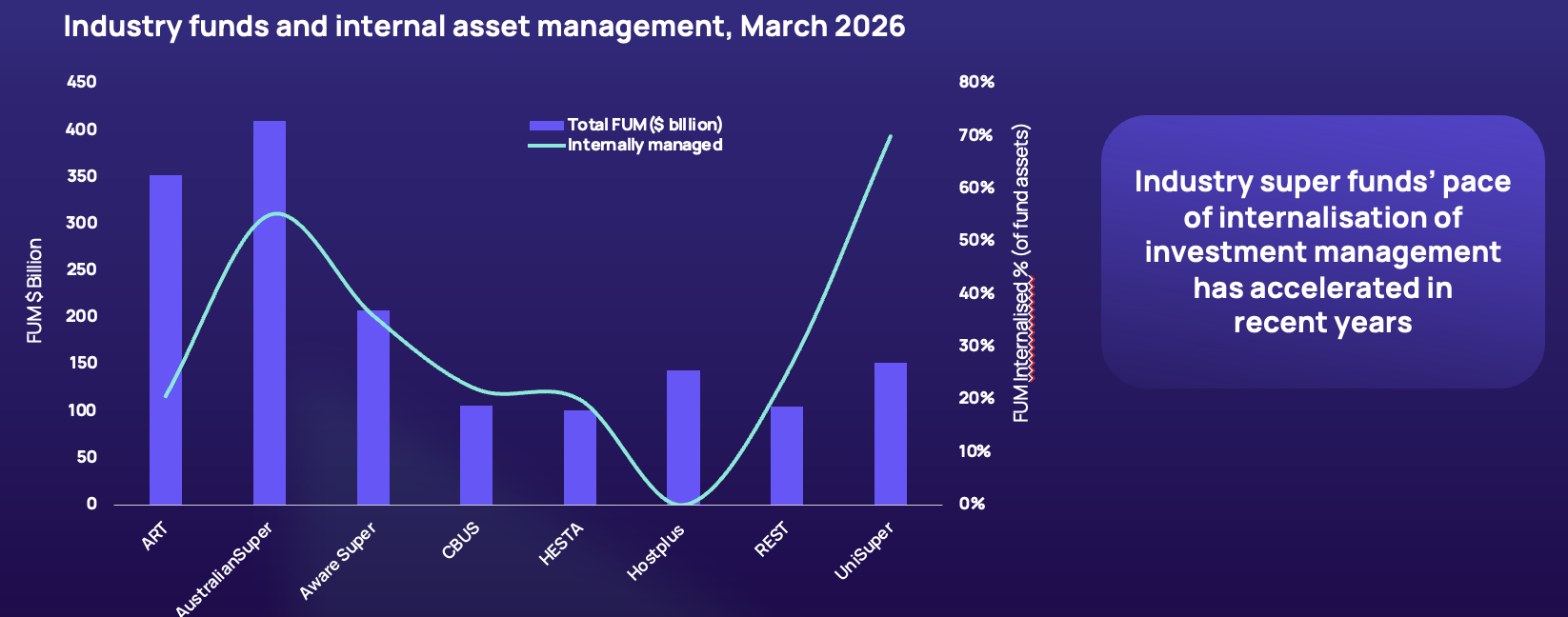
In Figure 5 we have selected industry funds showing their total assets and internally managed assets. UniSuper has been known for having the highest percentage of internally managed assets, but we see this trend ticking up in other funds as well. Australian Super, the largest superannuation fund, now manages 55% of its over $400 billion assets in house.
On average, around 35% of industry fund assets are now internally managed, and this proportion is expected to grow further in the coming years.
Traditionally, funds have operated within asset class silos, but as scale and complexity have increased, this approach is becoming less effective. A total portfolio approach or TPA shifts the focus to the total portfolio outcome, with decisions based on overall return, risk, and member objectives.
This includes dynamic asset allocation and more advanced risk budgeting, allowing funds to allocate risk—not just capital—more efficiently across the portfolio.
Liquidity management is also becoming central in view of member demographics shift. With more members entering retirement, funds are seeing higher drawdowns and more consistent cash outflows, while allocations to illiquid private assets continue to rise. Managing this balance at the total portfolio level is now critical.
TPA also improves coordination across public and private markets, ensuring exposures are aligned and not duplicated.
However, from a regulatory perspective, disclosure frameworks still focus on strategic asset allocation, creating a disconnect between how portfolios are managed and how they are reported. And to be clear it is not that fund switch from one approach to the other, but it is more of gradual mindset shift to look at a portfolio holistically.
Overall TPA is gaining momentum, particularly among large industry funds, and is likely to become a defining feature of investment management in superannuation going forward.
Currently there are various initiatives at play across APRA, ASIC and Treasury which are grouped into overarching key themes as displayed by Figure 6.
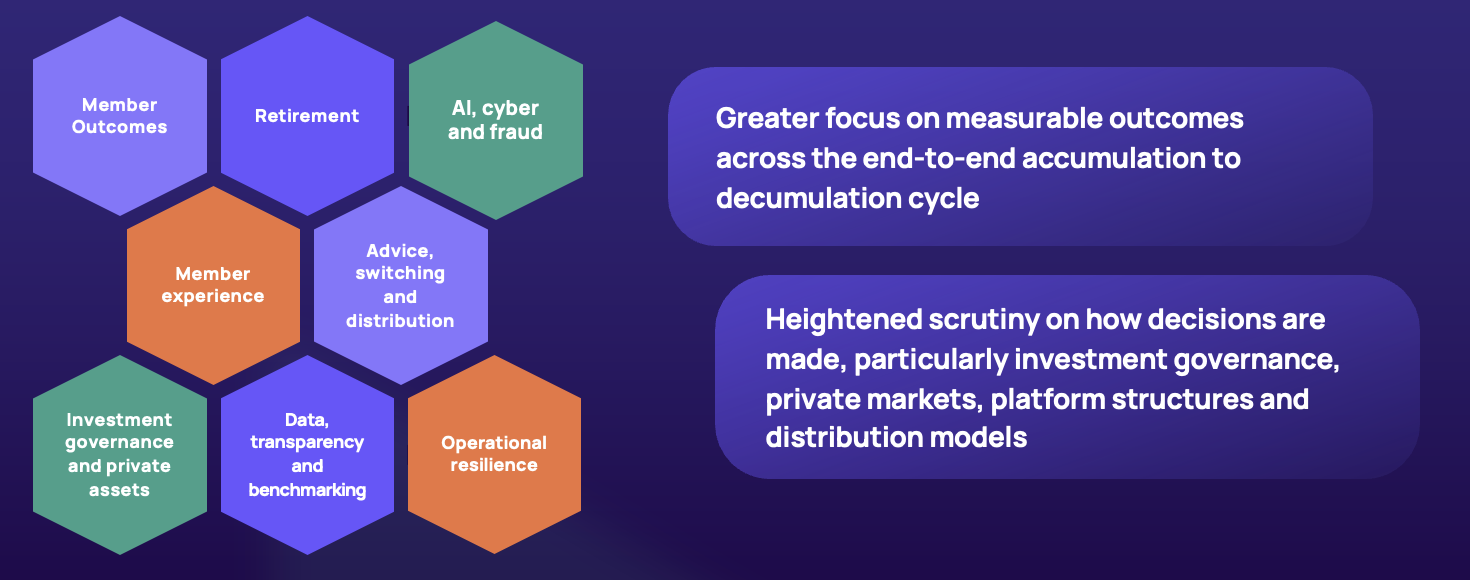
We have seen a clear shift over time toward measurable member outcomes, and that is supported by better data, greater transparency, and benchmarking particularly through APRA’s work, and Treasury’s proposed changes to the superannuation performance test, and the upcoming retirement reporting framework.
The introduction of Payday Super has also raised the bar for transactional transparency across the system and trustee operational competency. Meanwhile, Division 296 has shifted the focus toward member-level tax outcomes and balance management.
Historically, the focus has been heavily concentrated on MySuper. While that was appropriate, the expansion of the choice segment and growth among platforms has driven a corresponding shift in attention.
This was already underway, but the collapse of the First Guardian Master Fund (First Guardian) and the Shield Master Fund (Shield) accelerated it sharply and brought government attention and now funding with it.
Alongside that, the expectation of what a well-run superannuation fund looks like has changed. Regulators are not just asking what outcomes are being delivered, they are asking how, through what governance structures, and what risks sit throughout the entire value chain.
Enforcement has also sharpened, better data means better insights and comparability, and regulators are using it. The volume of enforcement action being taken has increased materially in recent years.
The risk landscape is also shifting quickly. “AI and cyber are the ones keeping me up at night,” Rainmaker associate director of research, Dr Camille Schmidt said. “On AI: most of us are using it, but the oversight frameworks are not keeping pace,” Dr Schmidt claimed.
APRA flagged this in a letter to industry in April, and it has been called out in their system risk report released in May. ASIC also released a letter in May urging industry to strengthen cyber resilience as AI threats intensify.
But the piece getting less attention is the cultural shift, that is, how AI is changing the quality and nature of information leaders are making decisions on, and the accountability questions that raises around disclosure and model bias.
With regulators increasingly focused on where risks sit across the value chain, the next question is: Where is money flowing? Because that is ultimately where exposure is building and where the attention of regulators is likely to intensify.
Looking at the growth in Choice funds under management that has occurred, platforms now account for 28% of Choice member assets and that figure has remained relatively stable over the last few years—from 27.3% in 2023. However, we are seeing a shift in terms of which providers account for that piece of the pie.
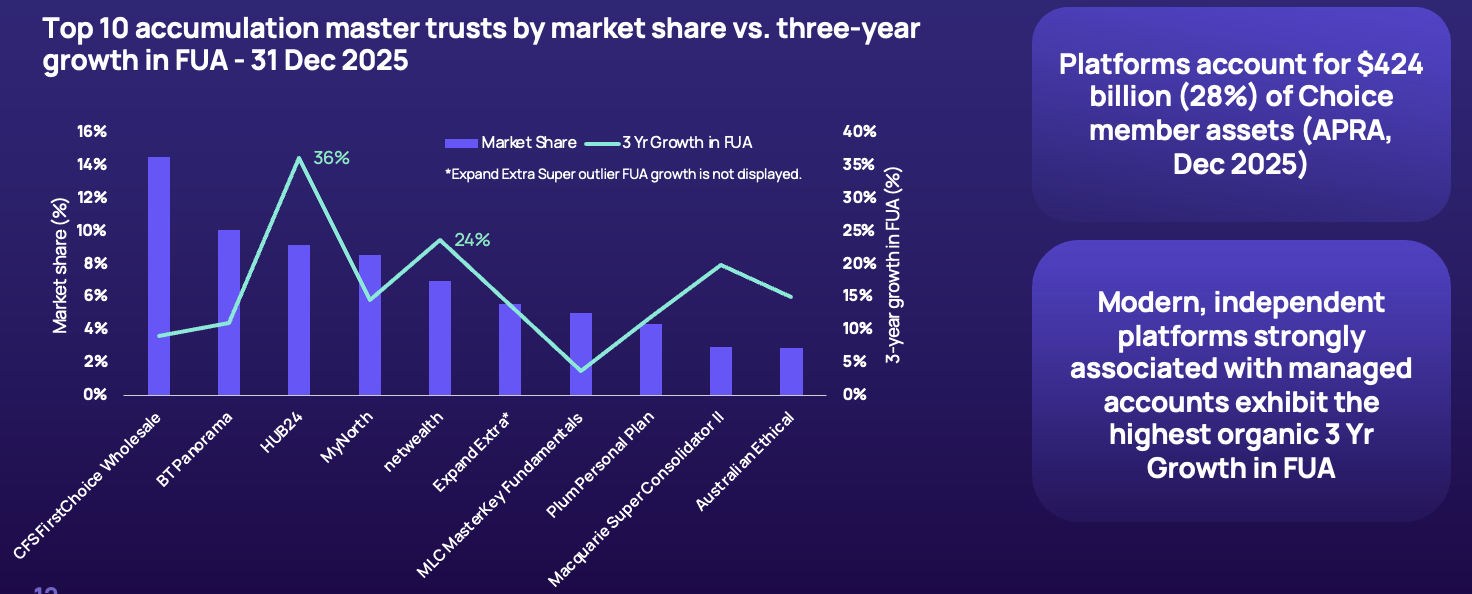
Figure 7 highlights the top 10 master trusts based on accumulation product market share alongside their 3-year growth in funds under advice (FUA) to December 2025.
We are seeing the highest organic growth among modern, independent platforms with HUB24 achieving 3-year growth in assets of 36% and Netwealth not far behind at 24%. Market leaders like CFS and BT have retained their positions but are growing more modestly.
"Treasury's proposal to identify high-risk products is problematic, as the industry still lacks consistent definitions for constructs such as growth/defensive splits and these vary across funds."
Four key consultations that Treasury currently has in train are:
• Enhancing member protections in the superannuation system
• Curbing lead generation activity
• Compensation Scheme of Last Resort – reform options to support ongoing sustainability
• Strengthening the superannuation performance test
It is worth calling out that the targeted work on curbing lead generation activity and ASIC's ongoing action against finfluencers is very well-directed. Closing the loopholes that allowed lead generators to fall through the cracks of the anti-hawking regime is necessary and very well overdue.
But the member protection package itself is a different matter. The suite of proposals is largely a response to the Shield and First Guardian collapses and legislating to a specific failure event risks creating rules that solve for the past, not the system.
“I’m arguing for reform that is proportionate and which will not create new problems when solving for the original ones,” Dr Schmidt said.
“In particular, the proposal to create a separate cohort of ‘platform trustees’ which would be subject to enhanced governance is conceptually blurred because a number of trustees operate both platform and non‑platform products.”
So, a binary classification would be difficult to apply consistently and could create arbitrary distinctions within the same entity.
While the suggested use of quantitative thresholds to define platform trustees such as the number of investment options offered is inherently gameable, a risk Treasury does acknowledge.
This creates a strong incentive for product design to be driven by regulatory avoidance rather than member outcomes. Member direct investment options and where they sit and how these menus may look in the future add another layer of complexity.
Treasury’s proposal to identify high-risk products is also problematic. The industry still lacks consistent definitions for constructs such as growth/defensive splits, and these vary across funds.
In this context, attempting to anchor a new regulatory cohort to these concepts, risks creating further inconsistency and uncertainty.
Regulators have also recently acted against platforms where conduct has fallen short, while other platforms managed similar offerings without the same issues. This suggests the existing framework can address the risks, and the focus should be on supervision and enforcement, not structural redesign.
The focus on platform-specific reforms is also diverting attention away from other priority areas, such as the Delivering Better Financial Outcomes (DBFO) reforms.
Bright-line definitions of platforms may also reduce product choice which creates incentives for members, particularly those who are more engaged or who have higher balances to shift to SMSFs.
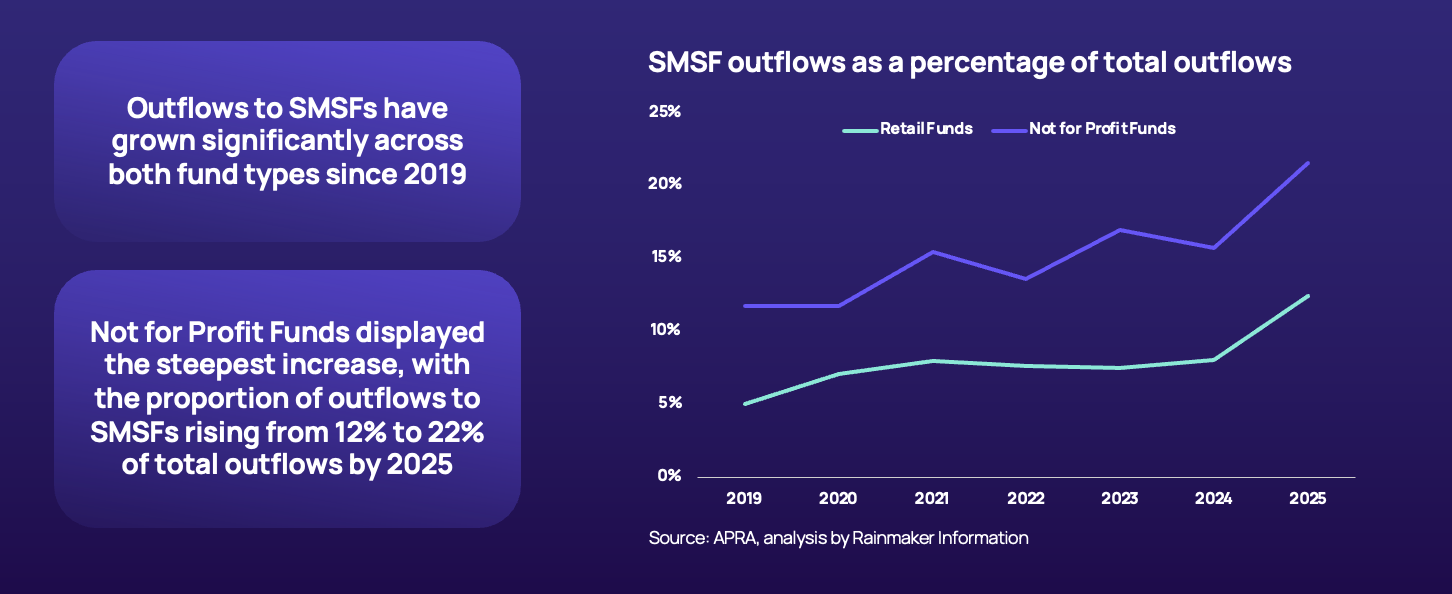
SMSF sector assets have reduced over time; however, we are seeing an uptick in outward rollover activity from superannuation funds, benefiting the sector. As Figure 8 shows, outward rollover activity from both industry and retails funds to SMSFs has been trending upwards since 2019 and adding to this trend is a material risk that should be balanced appropriately against the purpose of a platform trustee definition.
Essentially, reforms designed to strengthen member protection within APRA-regulated funds risk accelerating migration into the rapidly growing SMSF sector where the ATO’s compliance-based supervisory model lacks the prudential standards, independent governance requirements, and enforcement tools that define APRA's regime.
"Banning switching-related advice fee deductions is another proposal that misidentifies the problem. This targets the payment mechanism rather than the source of harm."
Mandatory holdings limits: A principles-based approach with clear regulatory guidance better balances concentration risk management with flexibility.
Moving on to some of the other proposals, in terms of mandatory holding limits, while diversification is a fundamental principle of sound portfolio construction, codifying limits in legislation risks creating unintended and adverse member outcomes.
The key issue is the interaction with taxation. Strict holding limits could force members to realise gains purely due to market movements rather than any change in underlying risk. This creates a conflict with the best financial interests duty.
Banning fixed-cost recovery style platform fees: Strengthening governance and transparency around fee arrangements would better protect members without removing a cost-reducing mechanism.
In terms of fee structures, most platforms charge a fixed shelf space fee. Dr Schmidt does not see a problem with this if it is underpinned by strong minimum onboarding criteria which cannot be skirted.
Product issuer fees can reduce the direct cost burden on members by shifting part of the cost of maintaining and administering investment menus away from the member.
Banning switching-related advice fee deductions: Risks more unadvised switching or SMSF exits.
Banning switching-related advice fee deductions is another proposal that misidentifies the problem. This targets the payment mechanism rather than the source of harm.
The practical consequence is that lower-balance members, who typically lack liquid assets outside of their superannuation, lose their only realistic means of paying for switching advice. That sits in direct tension with the DBFO reforms which sought to expand affordable advice access.
The ban is also easily gamed through fee restructuring, and the likely downstream effect is more unadvised switching or SMSF exits — neither of which is a better outcome for members.
‘Cooling off’ period: More time out of market materially disadvantages members exiting underperforming products.
Finally, the proposal to add a five-day cooling-off period on top of the existing three-day rollover requirement sounds protective but risks disadvantaging the very members it is designed to help. There is also no mention of whether this would be business days or calendar days. But eight days or more out of market is meaningful, particularly for members exiting underperforming products.
More fundamentally, a short waiting period does not address the underlying behavioural risk: a member under sustained sales pressure will not be meaningfully protected if the source of that pressure remains unchanged.
Firstly, enhancing APRA Prudential Standard SPS 530 Investment Governance in Superannuation and SPS 515 Strategic Planning and Member Outcomes guidance specifically for platforms would go a long way and APRA has publicly committed to a review here.
This is a more proportionate approach than creating a new platform trustee category altogether. “I do think there is merit in simple, targeted friction where the risk is higher, for example, a general warning when members are transferring out of the APRA and ASIC-regulated environment,” Dr Schmidt said.
Greater data sharing between regulators and with industry is key. A lot of this comes back to visibility: having consistent, timely data to identify emerging risks enables early action to be taken.
The regulators are already moving in this direction, but there remains scope to develop a more joined-up view to support oversight.
Stepping back a bit, one of the most important foundational fixes is improving consistency in how investment options are classified and labelled across the industry. This is a long-term issue, and it is not easily fixed but Dr Schmidt believes it is fundamental to the confusion that exists among members.
At the moment, even basic labels like ‘Balanced’ or ‘Growth’ mean very different things across funds. Until that is addressed, layering on additional concepts like ‘high-risk’ products is only adding complexity on top of inconsistency. If members cannot easily understand and compare what is in front of them, that creates the conditions for poor decision-making particularly under switching pressure.
Bringing this all together, there are some clear implications for the superannuation industry.
Takeaway 1: You do not need to become a platform, but you do need a personalisation strategy
Given the strong flows into platforms and managed account-heavy providers, industry funds are likely to be feeling the competitive pressure. But the point is not to say you need to become a platform; it highlights the importance of having a personalisation strategy.
Funds can achieve this through a range of approaches, for example, that could mean retirement cohort tilts with higher allocations to income assets within pooled options, tax-loss harvesting for accumulation members, or suggested portfolios framed around clear objectives within member direct investment menus, such as “this portfolio is designed for members seeking high dividend yields.”
The key is that this sits on the general advice side when designed correctly, guiding members through structured pathways, rather than recommending a portfolio based on their personal circumstances.
Takeaway 2: SMSF leakage is a growing risk to all funds
The risk of rising member exits to SMSFs is real, and SMSFs sit in a very different regulatory environment. The consumer protections are different, the advice requirements are different, and frankly the outcomes data is mixed.
This is not just a commercial risk, there is a broader member welfare dimension here. Education is part of the answer, but so is product design. If funds can provide engaged members with meaningful control and flexibility, the incentive to exit to an SMSF is reduced.
Takeaway 3: Not all regulation will land cleanly in practice
Many of the reforms on the table are designed as legislative fixes, but if implemented some are likely to create frictions once they interact with how products operate and how members behave.
Across the system, this can affect areas like advice access, retirement decision-making, and switching behaviour. Funds will need to design around these effects through product settings, governance, and member communication.
Takeaway 4: Data, comparability, and transparency will continue to drive action
Finally, transparency is only increasing. Regulators will use data to identify outliers, and outliers attract scrutiny.
Superannuation funds who are confident in their data, who can clearly articulate their fee and outcome story, and who lean into comparability rather than away from it, are the ones who will build trust with members and with regulators alike. In a market that is going to keep consolidating, that trust is a genuine competitive asset.
Contact our Business Development team to receive further details of Rainmaker's products and services.

Internally managed assets have more than doubled in five years—rising from an estimated $227 billion in 2020 to $550 billion in 2025.

Australian ETP market records $51.9 billion in net flows for 2025, up 60% year-on-year

