.svg)



The average proportion of assets managed internally rose from 9.3% in 2019 to 22.1% in 2025, according to Rainmaker Information’s analysis of 40 superannuation funds.
There is a significant shift toward in-house investment capabilities as funds grow in scale and sophistication.
The findings highlight an evolving balance between internal investment teams and external managers, with the trend most pronounced in liquid asset classes where large super funds increasingly have the size and resources to manage money themselves.
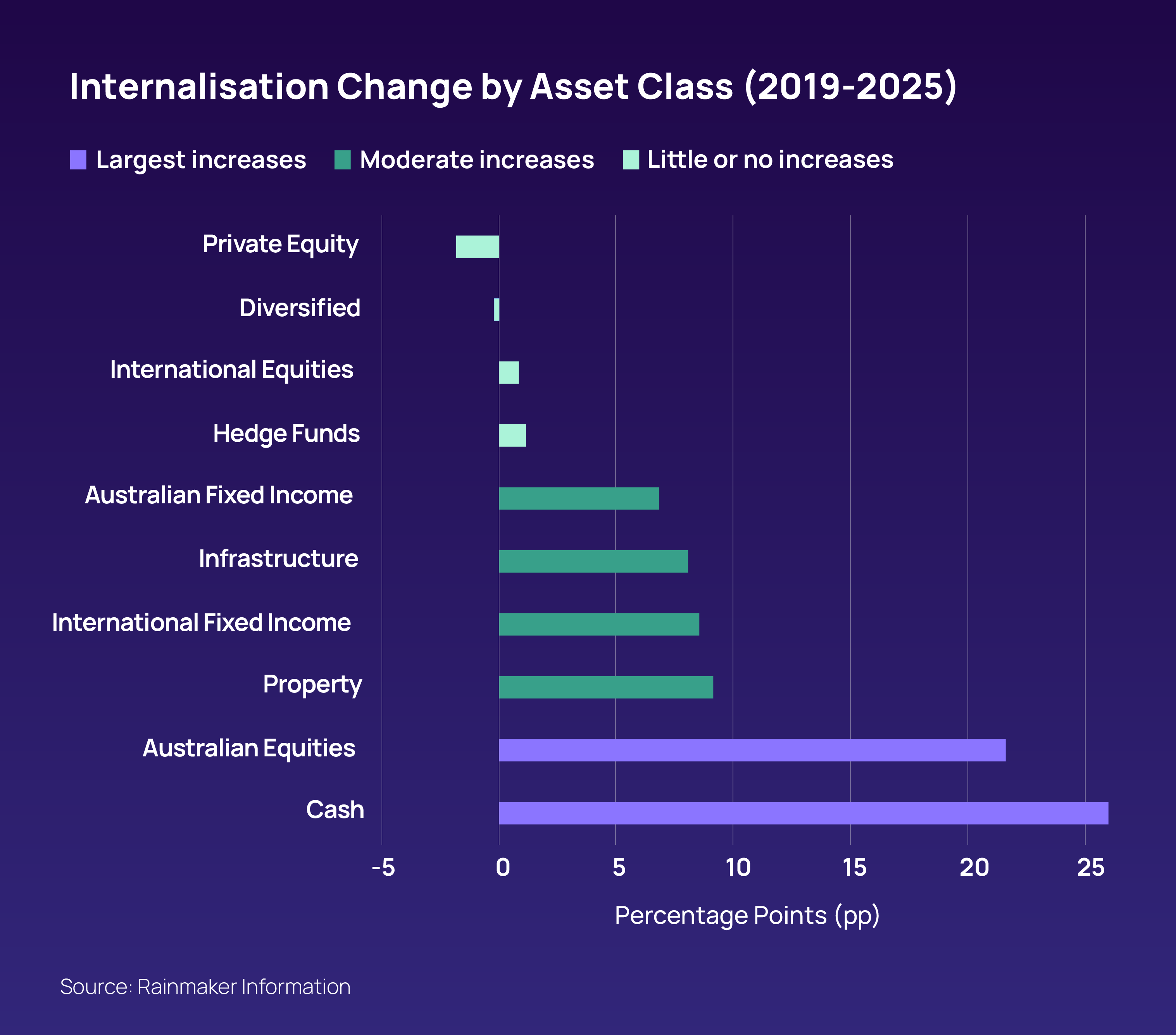
Cash and Australian equities recorded the largest increases in the proportion of assets managed in-house over the period, rising by 26.0 and 21.6 percentage points respectively.
The proportion of assets managed internally also increased across Australian fixed income, infrastructure, international fixed income, and property, while private equity remained heavily reliant on specialist external managers.
“The research shows internalisation is a defining feature of Australia's superannuation sector, although the trend is far from uniform across all asset classes," said Dr Camille Schmidt, associate director of research at Rainmaker Information.
"Growing scale is allowing some funds to bring more investment capability in-house, particularly in areas where they believe direct management can improve efficiency and member outcomes.”
Despite the rise of in-house investment management, external investment managers continue to play a critical role across the sector.
Analysis of around 8,400 mandate relationships found external mandates remain a key feature of super funds’ investment strategies, lasting approximately 2.9 years on average.
“While the trend towards in-house asset management is expected to continue, the emerging model is selective internalisation across both public and private markets, combined with external managers where they provide differentiated expertise, access, capacity or risk diversification,” said Dr Schmidt.
“For institutional fund managers, the research points to a changing competitive landscape.”
“Winning and retaining mandates will increasingly require managers to demonstrate capabilities that super funds cannot readily, or cost effectively develop and maintain in-house.”
“The result is a more selective mandate environment, where managers must demonstrate the appropriate scale, specialist capabilities and sustained performance to deliver value for increasingly large and sophisticated super funds.”
Contact our Business Development team to receive further details of Rainmaker's products and services.

Internally managed assets have more than doubled in five years—rising from an estimated $227 billion in 2020 to $550 billion in 2025.

Australian ETP market records $51.9 billion in net flows for 2025, up 60% year-on-year

